Is it possible to be a great art director and not use a computer? Or, is it possible to be a great art director if you use a computer?

Dear Students,

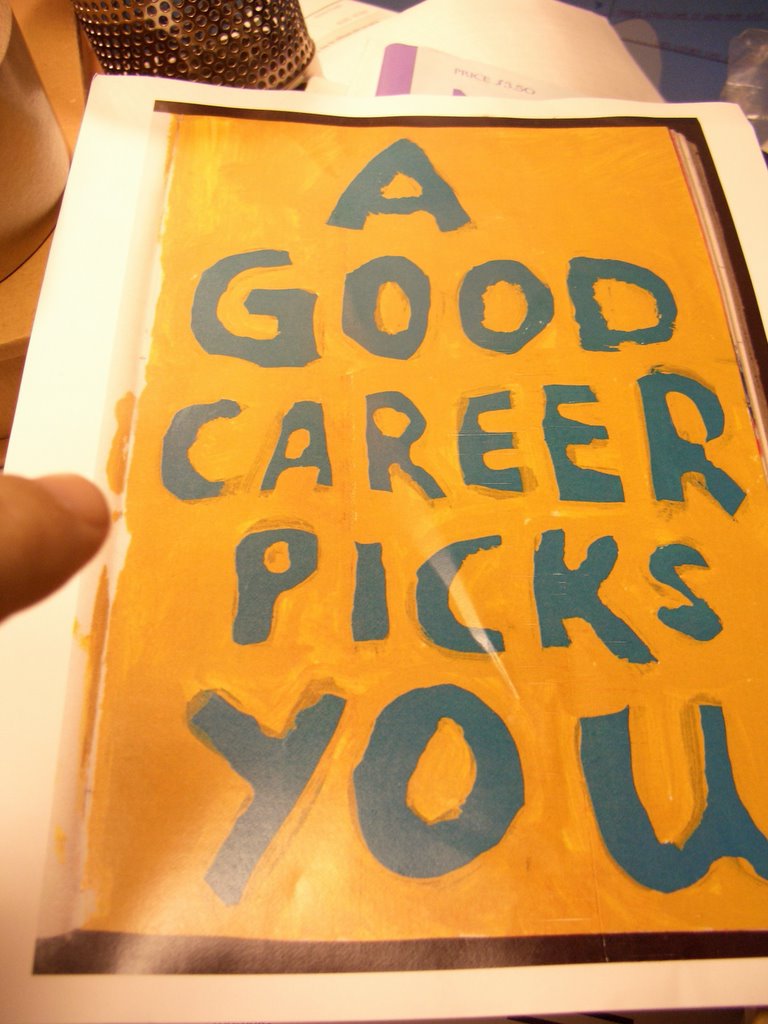
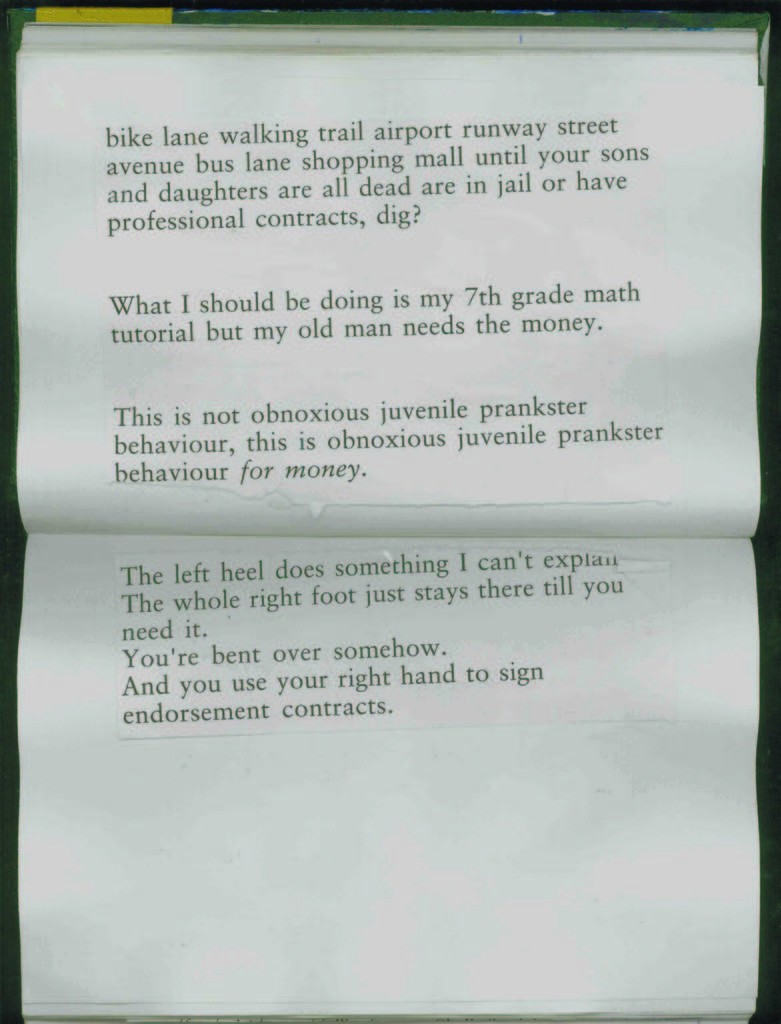
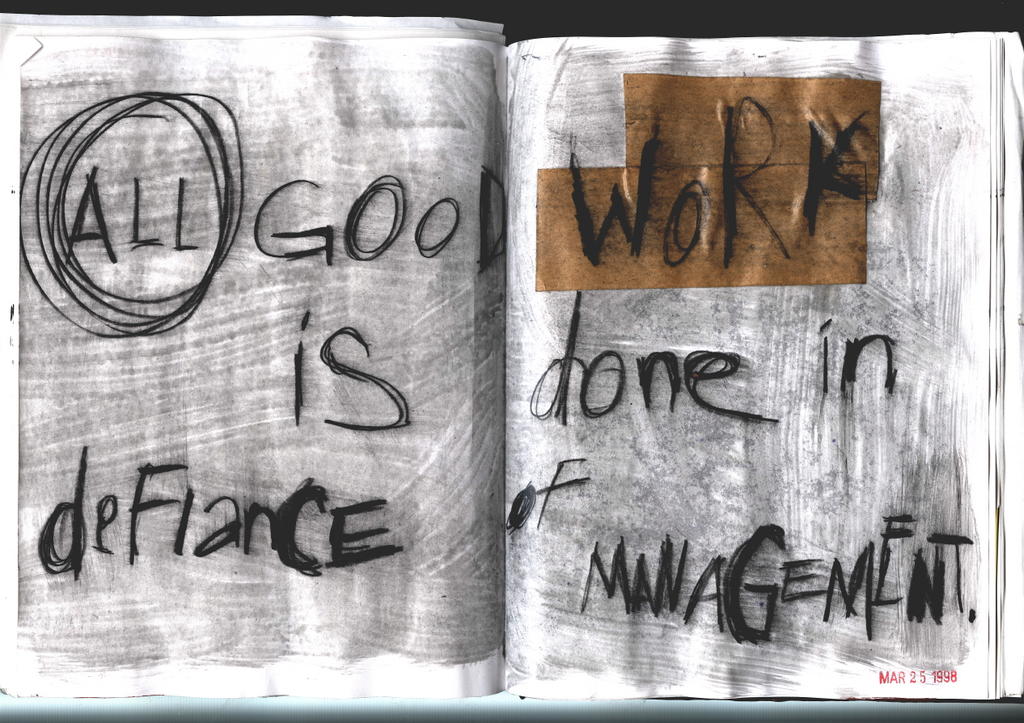
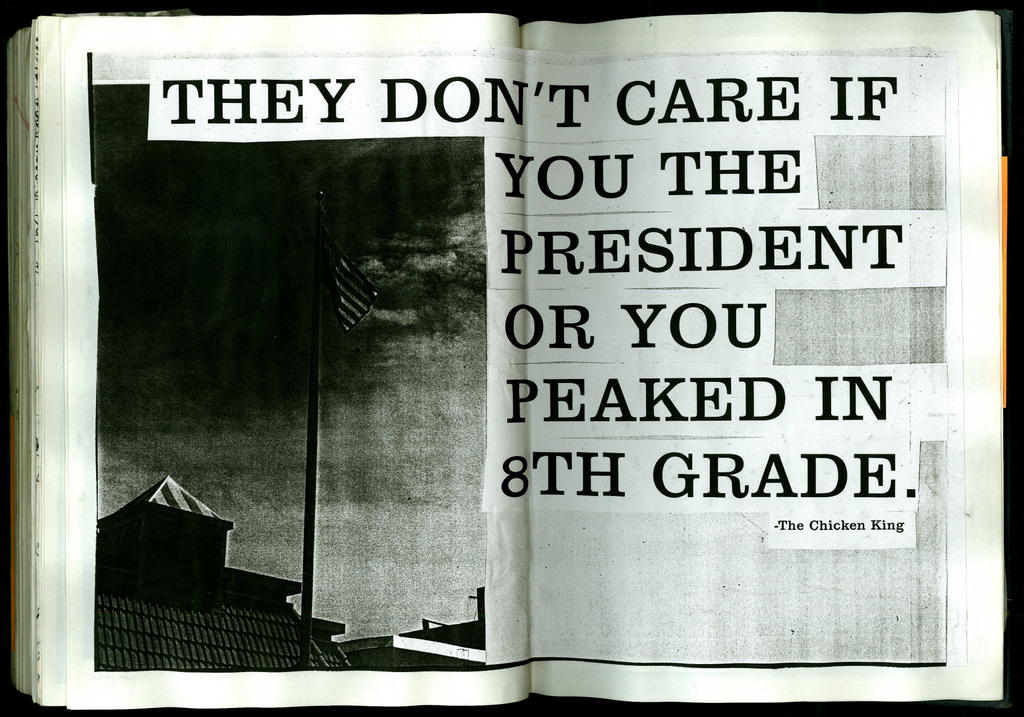
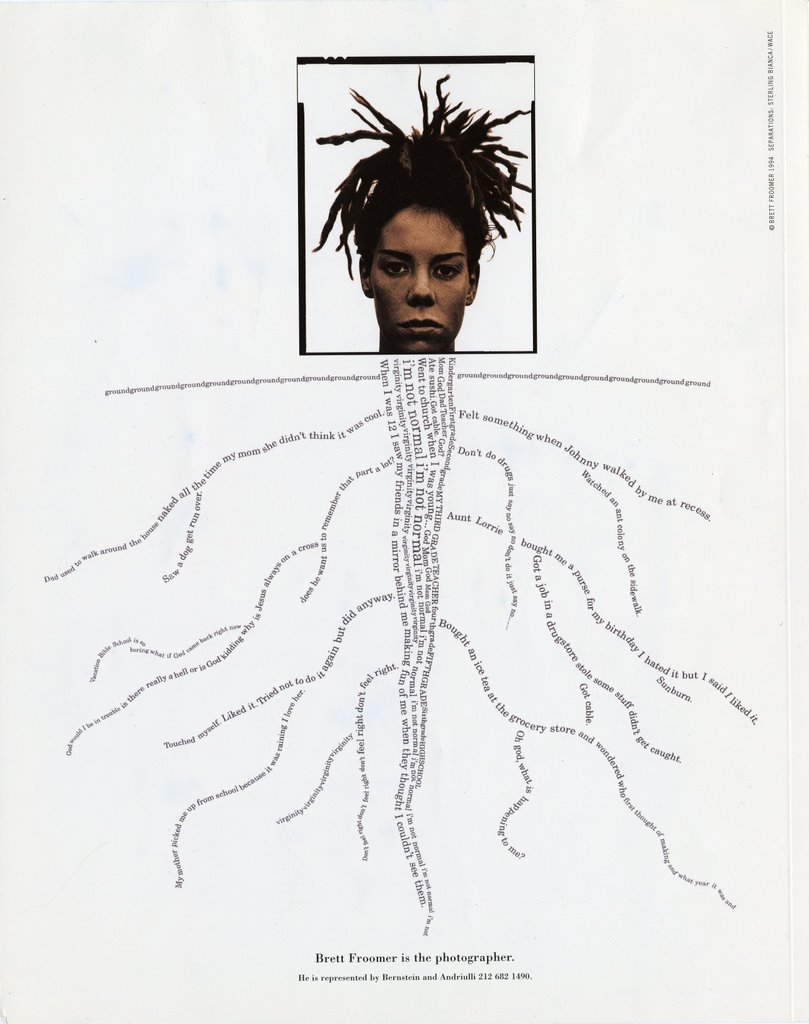
These two ads ran on the back cover of CA in the middle 1990’s.
Steve Luker was the art director.
I think they’re still good.
Some of the writing is ok, but, for me, their appeal is mostly that they don’t look like anything else.

I typed the words on a Mac Quadra and printed them on a black & white printer.
That’s the only contribution a computer made.
Mr. Luker cut the pieces with an exacto and glued them to a board in the arrangement you see here.
The decisions he made he made in real time with his hands.

(click on image to enlarge)

I applaud the work you’ve done mastering art direction on a computer at VCU.
I suggest you do not neglect to master the two tools that dangle at the end of your arms as well.
Only they can produce work no one has seen before.

If all art directors use computers,
and all computers are created by software geeks,
and computers can only do what they’ve been programmed to do,
does that mean all art direction in advertising is being done by software geeks?
(please, I wish to use software geek as a term of respect, thank you)

Where You Been Isn’t Who You Are. But It Helps.

Dear Students,

I got hipped to a website by Felix Yip, that wacko Canuck planner who spilled paint on the floor during the first Creative Thinking class last year.
Probably you been to his site– felixyip.com– and seen this map there on which you can have the countries you’ve been to marked in red.

create your own visited countries map

An old guy like me has been a few places.
You think.
Until you look at this.
I haven’t seen anything yet.

I have 2¢ worth of advice.
It comes from having started working in junior high school pulling sludge out of sewers at a do-it-yourself carwash in Ann Arbor, Michigan.
From having worked a night job all through college.
From leaving town the night after graduation from Michigan State to drive to a job in Colorado.

It’s good to work hard at a job.
It’s also good to work hard at you.

It’s not graduation time.
But it is time to start thinking about what you’re going to do after graduation.
Don’t go look for a job.
Go see something you’ve never seen.
Go see something you’ve never seen and stay there for a while.
Agencies that have internship programs in the summer aren’t going to hire new people while they’ve got the 1st year interns working for them on the cheap.
Go get your head turned around in a country that’s not on your red list.
You ain’t never again going to be so young and pliable.
Go make it work for you.

This is not a picture of God.

This is not almighty.
I can tell you that most of the impact it will have on your life will be detrimental rather than enlightening.
I don’t expect you to believe that thought whole–you’ll have to earn that wisdom yourself–but there’s a chance you’ll consider it for a 3 month period. So I offer it.

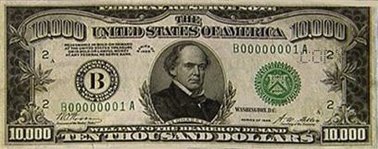
You got plenty of time to serve the dollar bill.
Serve your mind.
Go.

It’s February. Time to let Mr. Wacko in.

Dear Students,

By this point in the term you’re up to your necks in briefs.
(for the benefit of any non-ad-agency folks who’ve ducked into this website, a “brief” in this context isn’t underwear, but a one-page summation of what an advertiser is hoping the ad campaign his agency creates will accomplish) 
There’s plenty that can be said about the value and the lack of value contained in the average ad agency brief.
I don’t aim here to get into that.
My focus is more narrow.

I’m concerned that you may make the mistake of thinking that work which “answers the client’s problem” as written in the brief is work that has done the job of advertising and is therefore good work.
Negatory on that, rubber duck.
Answering the client’s problem is only part of the job a good ad does, and not at all the most important part (more about that later).

Good advertising forms a connection between speaker and audience, between advertiser and people, that human beings enter into willingly, even hopefully at times.
Merely broadcasting the aim of your client into the eardrums and eye sockets of your brothers and sisters is neither the aim of good advertising nor an effective way to positively influence sales of the client’s product.
Half a connection isn’t a connection.

Here’s where you need to summon Mister Wacko.

What catches your eye when you walk around?
To what are you drawn on television/in grocery stores/art galleries/music?
Me, I want something I don’t already know.
My eyes want to feast on a sight they’ve never seen before.
Ears too. And smell and touch and taste.
They all want in on the new.
You’re the same, and so are all the people on earth.

If all you care about is the client, that’s who will listen.
Care about the audience sitting out there more than the client and you’ll have a chance at connecting with that audience.
Don’t, and you’re a shill, that’s all.

Answer the client’s need only and you’ll have something nobody wants to listen to except the client–and even he will only do it because he feels he has to.

Answer the audience’s need only and you’ve got something people will at least watch/read/listen to.
–But if the client’s logo at the end doesn’t form a palpable connection or bring to the audience anything they care about or didn’t already know you’ll have interrupted their life under the promise of having something to say, but not come through. Audiences tire of that. However, your work at least won’t leave the audience with the sense they’re impotent sheep who can be ordered about at the whim of big advertisers, as most advertising does.

Answer the client’s need as well as the audience’s and you’ve got a chance at great work.
It takes magic, ludicrousy, fancy, blind-flying & something hidden from probably 99.7% of the people on earth to bring an audience what they don’t know.
It takes Mr. Wacko.
A willingness to love what it makes no sense to. A penchant, sometimes, for turning an exact circle away from what everybody arounds you says is true and going in the opposite direction.
These are crucial willingnesses, not something you can allow yourself to be afraid of or talked out of by the normal people around you.
Of course, in addition to letting Mr. Wacko in, you’ve got to not lose the simple, common sense of what everybody does know & feel & trust in as they walk around.
Takes both.
It’s hard to make a connection between people wanting different things and to make that connection under the pressure of a deadline, why are we surprised it should take a madman?

How do you do it?
I come back to this admonition so often you must be tired of hearing it. It’s true anyway.
Do your work in a book
Carry it where you go.
Keep in it not only what you make but fill it with samples of what weirdnesses reach out to you.
Get used to letting what calls to you inform & lead & infect what you do.
Isn’t there enough normal in the world already?

Resist the pressure to be who you are not. Strive to give yourself over to the gladness that you are who you are. P.S. There are ideas in the latter.

Dear students,
As you’re about to return to AdCenter from the Christmas holidays i’ve an admonition for you.
The danger to your development an ad school poses is:
there’s more pressure to be like someone else than there is encouragement to become more of who you are.

I am a midwestern boy.
Michigan, Ohio and Illinois.
I lived in each of them growing up.
As an adult i lived 10 years in LA.
Loved it. Beach. Sun. Wonderful.
However, while i was in LA i tried for some time to write like what i saw being bought by Hollywood.
(i’d describe it to you but i never got a firm hold on that slippery fish)
What i do have a grasp of is how much of a mistake all that effort was.
Not only did i write a bunch of crap trying to fit a conjured-up style that wasn’t mine, but, worse, writing that way was so uncomfortable i didn’t do much of it.
Mistake compounded.
It’s one mistake as a writer to do bad work.
It’s a whole another worser problem when you ain’t doing much of it.
I didn’t find success with that stuff.
Thank God for that small mercy.
Moral of the story: writing from who you aren’t isn’t a career, it’s a sideshow.

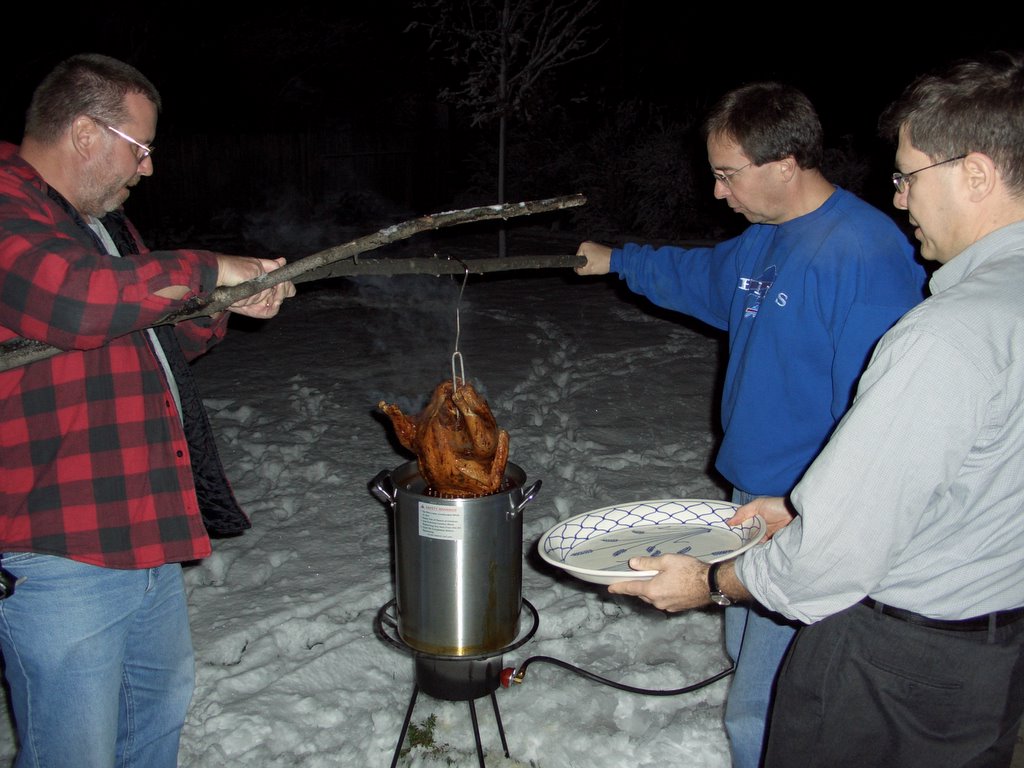
This is me.
(not literally–these are 2 brother-in-laws and a friend)
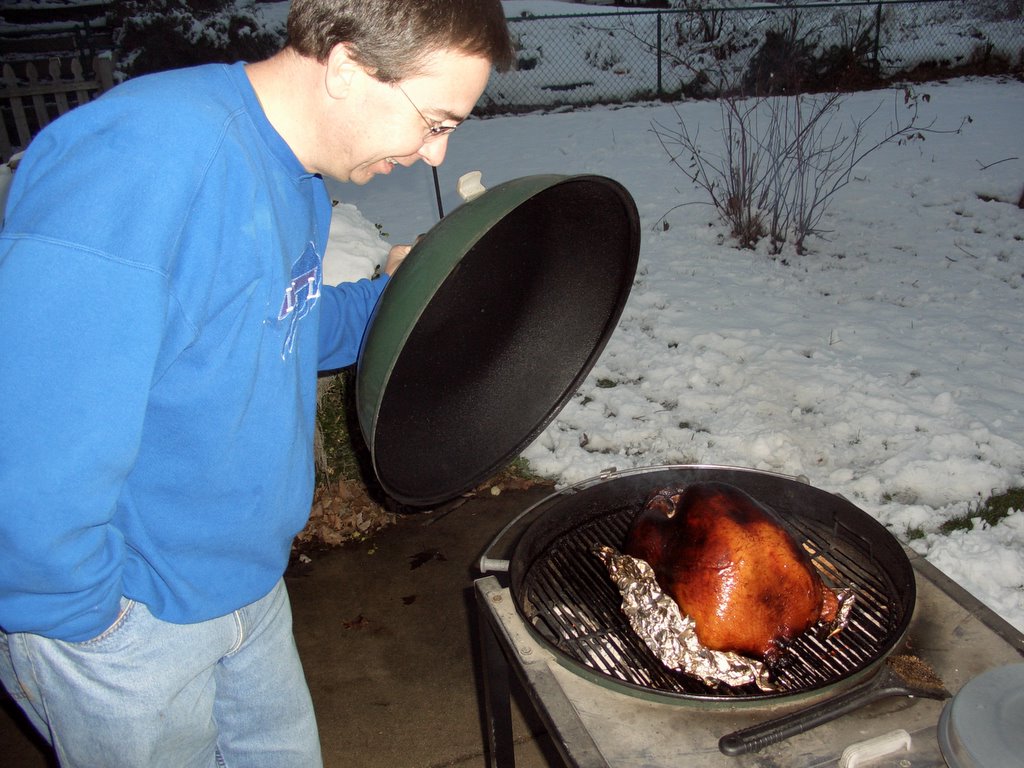
A michigan-football-watching, deepfried-turkey-eating, flannel-shirt-is-a-coat man of the prairie.
A barn-sized door-filler from the offensive tackle-producing breadbasket of the country.
The kind of guy who wants another turkey on the bbq while the first one is in the deepfryer.
Just in case.

This is where i come from/who i am.
Things unrefined, unrecommended & unbeautiful arouse me, touch me with a kinsman’s embrace, and speak to me in a dialect unhearable to those who could watch the ’85 Bears’ Super Bowl Shuffle and remain tearless.
When i sit down to write, beer & sausage is what flows in my head.
If i try not to be who i am; if i try to be someone cooler or slimmer or better dressed or the umpteen dozen other ways in which this model could be improved, into what flow inside me am i going to be able to tap to feed the pen that sits at the end of my hand waiting for ideas?
There’ll be nothing.
Nothing human or new anyway.
There’ll just be that nasty-faced bugaboo that doesn’t like me like i am staring back at me with an empty expression that says “go find something to say from somewhere else, buddy, cause what you got in here we don’t like.”

Great work in advertising isn’t about making people feel bad about who they are.
The work produced from that starting point is the kind of work people without souls are willing to do if it makes money. That’s all.
Great work points at value.
It finds people at their most human and says, there, like that.
(most conspicuous recent examples: vw work from arnold)
You must be as human as you can be to generate connections between products and living/breathing/thinking people.
If you’re doing the hate-yourself-want-to-be-like-other-people dance you will find it as near to impossible as i can imagine to create something new.

I know you can make money from that stance.
I see it every day.
You can sell a ton of that stuff if you’re practiced at giving back a shinier rendition.
If someone shows you a piece of work and asks you to work like a xerox machine that changes it just enough to get away with, there’s a lot of paychecks out there.
If you are able to give back something just a little bit cleverer than what someone holds up as a model, you betcha there’s a way you can maximize the monetary reward for that.
What you can’t make is progress.

Genuine progress in moving the ball of human knowledge & understanding forward does not come from the work you do when you pretend to be someone you’re not.
It comes from you being you.

I swear i would tell you if this wasn’t true.
If there was a slick, intellectual, simplistic way to go forward i swear i would not hold back the knowledge of it from you.
There isn’t.
When you try to be who you aren’t into what inner resevoir are you reaching?
When you put your hand down into a yourself that doesn’t exist, with what will it return?
There is one way forward.
It occurs inside you.
You become more of who you are.
You step forward on the feet that are yours.
You feel the bottom of whatever pool you walk into and tell us on the shore what only you know.

There’s no magic formula.
There’s no way to know how you’re doing.
You do it.
You reap what you sow.
And the world makes up its mind outside you about how much attention to pay you and how much worth to assign to your work and in the end the most important assessment of all is the one made by the only person who was privy to all the circumstances, you.
What matters is what you think.
I promise there are ideas in you being you that there aren’t in you trying to be someone else.

What Grades are Good For in a Perfect World

Last semester of my senior year of high school i had an extra class hour to fill and nothing required left to take.
I understand this situation is typical now, and that courses in bowling and french movies have become the hip choice for senior boys hoping to become men, but it was unusual then, or was to me.
I tried to think what i was good at.
Latin? No. Math? Yikes. Could sing, dance, act or play an instrument?
Nothing.
I wasn’t the type to take home economics (still ain’t) so I looked at my report cards for the last 3 years of high school to figure out what i was good at.
That’s when i noticed i got A’s in english.
From there an elective class in “creative writing” was an easy choice.
And, the first day, when i came in and discovered that in this class i was surrounded by all the beautiful girls in the senior class, i believe i took the first steps down the road that turned into the work i do.

I wasn’t smart enough to know how to go about the job of finding a job for me.
I was lucky.
Heck, i didn’t even know that day in high school that what i was doing would decide what i would do.
It was an instinctual choice to go find those report cards and look at them.
It was not a considered thought to pick what class to take according to what i was good at.
It was the only thought i had.
But it’s a step i see some people who come to the school and who come to advertising, missing out on.
They make a choice to be in advertising for some other reason than that they’re good at it.
They want to go on tv commercial shoots in LA & drink martinis at the Mondrian.
They see a future full of first class travel, prada suits and coffee brought to their hotel rooms in silver service.
They like the idea of wearing jeans to work and taking three hour lunches at the best Polish restaurant in Detroit.(sorry, you’re stuck with my ideas about fun–that’s the place there on the right. it’s in hamtramack. click on the photo & you can read the address)
All excellent experiences.
But.
The thrill of them lasts only a few seconds while the hard work of being a copywriter or art director never goes away.
Any performer will tell you–and that’s what being an advertising creative is, it’s about performance according to schedule and there is no answer to when it’s done or good enough except for the one you give– the job is ever near. It never goes away. In the front of your mind at the office, in the back of your mind at the grocery store, the archery range or in bed.
Look at your grades.
Listen to what they say.
And not just the ones in school.
Look at what you do well.
Look for the calling.
That’s where the job you want is.
That’s where the job that wants you is.
(what does this long drag of a story mean in practical language to a student, you wonder? it’s only winter break, you’ve still got 5 months of school left if you’re 2nd year. This is all i ask: try some new things and see how you do. try the opposite of whatever you’ve been doing. If you can’t think of anything try asking people who know you what you’re good at. You won’t believe what they say, but they’re worth listening to. Mothers. You can trust mothers)

A change now, of year, and of where the computer resides on which I type these.

The flag of Oregon is the only state flag with different pictures on each side.

Both sides have a field of navy blue with design in gold.
The front shows a heart-shaped shield with an eagle on top surronded by thirty-three stars.
( The number of states in 1859. )
The scene on the shield is the sun setting over the Pacific Ocean, mountains, forests and a covered wagon.
A plow, wheat and pick-ax represent farming and mining.
Of the two ships: The one leaving is a British ship and the one arriving is a United States ship representing trade.
The eagle represents the United States.
On a banner are the words “The Union” representing support for the United States.
Finally the flag is emblazoned with the words “State of Oregon” above the picture and the date of statehood “1859” below. (from 50states.com)
The beaver is the state animal, though this was determined without the written or spoken acknowledgement of any known representative of the species.

Terrific art direction in that flag.
Done without a computer.
When a person art directed a flag in 1859 it meant more than most communications do now.
Soldiers would carry what you designed into battle.
Governors and presidents would stand next to it.
It was going in books.
Here’s the question: do we not respect the work we do now as much as the work from a hundred years ago because there’s so much more of it now, or do we not respect it because we don’t make work meant to last, meant to be iconic, meant to mean something?
Conundrum.
If we do remarkable, salute-able work, will it draw from the audience a greater response?
Or is that over?
Can our post-modern hearts not gather feelings for symbols anymore?
What i like most, and what i think lasts, is there’s a story in the symbols.
There’s always a story in anything that lasts.

Finish your work. Copywriters, especially. Reading a bunch of 8-year old headlines you couldn’t sell and not knowing what they could have been, sucks.

I usually work in longhand in my workbook until i get a sense of where i’m going.
Then it’s faster to type so i switch to the keyboard.
Maybe it’s that way for you. Any way that gets sentences down is cool.
Doesn’t matter.
This does:
An ad is not done when you glue the headlines you typed in your workbook.
i’ve got hundreds of pages like this.


Headlines i never sold.
Some the art director didn’t like, many i never told him or her about.
When you’re writing them you want to get them down, you’re typing fast, you may be saying them out loud to your partner & killing them as you go along.
Don’t.
Ads (tv, poster, sticker, the format doesn’t matter) aren’t done when you know what they say.
Until you know what they look like, what they sound like, how they feel when they start, whether they have an ending or not, you’re not done.
Good ideas are so hard to find you’d think we’d have more respect for them as we’re trying to make them up.
A page full of headlines glued into my workbook now strikes me as a lot of missed opportunities, not proof that i deeply engaged with the subject.
I didn’t take time to see the idea that each headline was a starting point for.
I didn’t see the characters involved, the stage upon which each might have been played out as a drama.
Every headline you write is a starting point.
Don’t dismiss them quickly.
Don’t drop them because they don’t have a comfortable rhythm.
See them acted out.
If there’s excitement in a new thought that comes from that, drop the headline (don’t worry, it’s still in the book) and follow the new thought.
The farher away from an entry point you can take a line of thought, the less likely it will end up as a piece of work anyone has ever seen before.
Headlines are something to start with, not end up with.

It is what you do not yet know that is yer friend most.

My buddy Ray and I only got lost once while walking the Coast to Coast trail across England earlier this month.
Our solution was to follow a compass direction hoping to get back on the map.
(there was also a road we could have followed that would eventually have given us a clue where we were but we didn’t take it)
This is the field we were standing near when we decided what to do. Nice eh? Notice, however, that there’s no path through it.

3 weeks after getting back, it’s this field and being lost and figuring out how to not be that seems like the best memory from the trip.
Not the idyllic meadows we crossed in sunshine.
Or the steep climbs.
It’s the conquering of the unknown.
I bring this up because our brain’s default position in every situation we face is to angle for the way that gives the most comfort, or is the most efficient, or hippest or cheapest.
The brain is rational. The brain aims to keep the status quo until something more comfortable comes along.
The brain needs tricking.
To create at a high level you must trick your rational brain into sitting down and letting the rest of the grey matter work.
I’ll go into tricking the brain in detail in an upcoming post about using the workbook. All i’m aiming at here is to point at a small thought:
In your quest to make interesting work you must not choose the comfortable way.
You must not do what is efficient or logical or what satisfies someone sitting next to you.
You must overrule your brain.
You must march out into the field you don’t know.
Anyone can follow the road. Dig?

The first day of school is the hardest.

You don’t know who you are.
You don’t know who’s sitting next to you.
You don’t have any clue if you’ve chosen the right track to study.
You don’t have much more than a guess whether or not you’ve got talent.
(and how much talent you do have, as you will discover, has little to do with success)
I’ve thought about what it feels like to sit in my class on the first day.
I’d taught for 10 years before this nugget of wisdom came to me.
It sure ain’t much, but it’s all i got.

Welcome to what you’ll never stop wishing you could go back to once you leave.
Welcome to graduate school.

In order to create at a high level you must feed the machine that’s doing the work. Having a workbook and relentlessly pounding into it ….

This is something i drew in a workbook a few years ago.

I’ve had a workbook going since about 1985. I doubt my brain would work if i didn’t. I’m surprised i ever did a lick of any kind of good work before i started keeping my work with me. I used to work on yellow legal pads. I’d throw ideas i didn’t like in the trash. I was ignorant.
i didn’t start with the idea i’d make a cartoon. i remember thinking/writing the idea of the guy with a sign protesting being rich. The idea came first, then the image of the guy with a sign, and then i revised the words to go on the sign.
After i looked at it i thought a line was needed underneath to explain the joke. i thought it was funny in a dark way i like things to be. Now i think it works better without the explanation. (when is that not true?)
Most of what you put in a workbook goes nowhere. But you have to, have to, have to put everything in. You’ve got to pound it in. Because you never know what is going to come out of the process your brain does.
Looking at the bit now what i like is different from what i liked back when i did it.
Now i like the offhanded lean against air of the guy with the sign. I’m no drawer, but i like the accident that happened. It suggests how it should look on film.
Money is like computers. Doesn’t do anything people say it will, but ain’t nobody trying to get rid of theirs.

What goes into the workbook. It’s not sacred. It can be a silly thought like this one here.


Don’t treat it like it’s anything. It’s not. It’s hay for the horse your brain is willing to work like.
Even more likely, your workbook will be full of undramatic pages with lines & thoughts & unbaked ideas scribbled all over. Like this:


Good. Get it all out. It’s work, not art at this point.
It needn’t be written. I fancied myself a naive painter for a few deluded moments. I worked with cheap paint and charcoal and easy stuff. All i did was make lines look different than the typewriter could. Silly. Looking at it now, though,

and pulling out maybe this one from a hundred pieces of crapola, it’s a look I don’t mind. It seems to serve the thought of the line. I don’t paint this juvenile stuff anymore. With some years remove i can see that it’s what the words mean that i care about and have some interest in moving around.
When i’m working on a real project i’ll have different approaches to the same headline plastered into the workbook (wood-glued, actually, i like the crinkle effect it has on the pages and it doesn’t seem to add as much bulk as tape, although that’s likely not to be true by the laws of physics now that i think of it) This is an ad idea from 1996 or so done for KFC.


I doubt we (Steve Luker & myself) were thinking of it as a print ad. We were just getting ideas down on paper. No, wait, i think the idea was to make a book of sorts introducing these characters we’d made up & their philosophy.


Anyway, just get the stuff down on paper and look at it different ways.
I should own up, in defence of Mr. Luker who is an extraordinary art director and would choke himself to death if he thought for a moment that anyone had been given the impression he art directed the roughs in my book shown here, that i probably stuck these headlines on these pictures myself.
But that’s the point. Get whatever you think or see down in the book. Don’t waste time putting it down or critiquing it in your head, get it down in the book.
Don’t think about it being final. Don’t worry yourself, just hurry yourself. Your brain will keep up with your hands. Get stuff down.
I could go on and on.
I won’t.
Let me stop here with a final encouragement about workbooks.
The job of a copywriter or art director isn’t fun and it isn’t easy.
Jackasses often get the final say about whether our work runs or is even presented to a small group of people.
Genuine hacks often are given free rein to edit our work.
There is no honor in the advertising business.
Although you cannot create high level work without approaching it as an artist, you will not find yourself treated as an artist.
In short, you will not be able to love the job of advertising copywriter or art director as you would like to.
Do not fear.
Your desire is not muted.
Only misdirected.

(Kate Flather, i think, art directed this for me–we were working on tshirts if memory serves)
This, i have found, is what can happen.
The process of creation is worthy of love and will return to you what you seek.
The workbook is both the repository of your work and the feeding mechanism for your brain in the process.
Do not waste your love on the business. It cannot meet you where an artist deserves to be met.
Love the process.
I’ve written here clumsily perhaps, but i hope only to encourage use of the workbook, not to explicate it prettily.