Chinese propaganda posters from a museum exhibition in NY

People want to know where ideas come from. i think they want to know because they’re afraid their ideas aren’t any good and they think if they knew where the spigot was they’d go turn it on and ideas would gush out.
i don’t know where the idea spigot is.
i’m pretty sure there isn’t one.
i’m pretty sure ideas don’t come out in one whole piece from anywhere. i think the brain makes up ideas out of all sorts of little pieces it takes from whatever it’s been feeding on.
i think ideas come in pieces.
Maybe you’re at a museum in NY. You see this poster. Your brain stores away something from what you see. Maybe it’s an impression of an aggressive protest.
Or, maybe you get taken over by the look of the whole piece on a page.
Or you hear a tiny voice calling to you in a typeface.
Maybe the piece itself does nothing more than make you think of something else and your brain stores away that little piece of what the poster made you think that catches you.
We have so little control over what catches us.
What you do have control over is what you do with the little piece your brain caught.
You have to keep it with you.
You must make it a part of your process.
If all you do is get a copy of it and hand it to a technician and say there, that’s what it should look like, that’s nothing. That’s copying/cheating/not art.
But putting what catches you into your process by storing it in your workbook where it has a chance of being seen & studied in the context of what you’re working on, then it goes into your brain and your brain will use of it what it can.
Sitting there on a page it kicks in a door somewhere in the corridors of your brain.
Later, some brain cell walks past that door and looks in.

Not everything that catches you shows up where you think it might.
Few of the things that catch you do anything at all, probably.
But all fuel the process.

i don’t think there’s such a thing as writer’s block.
I think there are times when we’re not in the process. When we haven’t fed the brain anything to get excited about.

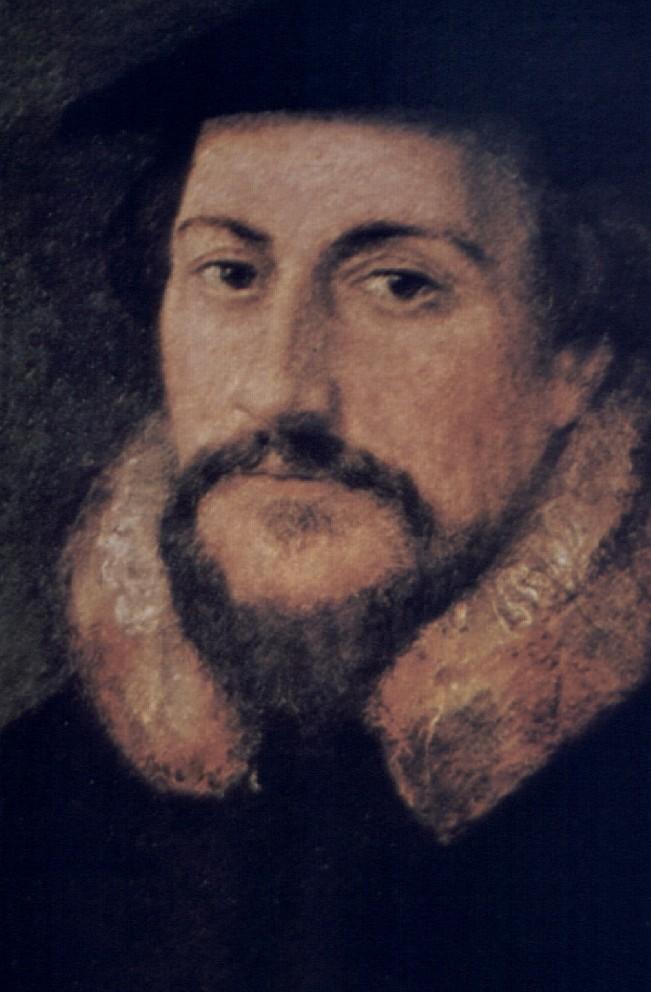
“True and substantial wisdom principally consists of two parts, the knowledge of God, and the knowledge of ourselves.” -John Calvin (1509-1564)

The opening sentence of “Institutes of the Christian Religion” by John Calvin is not only something i believe is fundamental to living, but fundamental to becoming a high level advertising creative.
I know i sound silly saying that.
I mean it nonetheless.
It will take me a while to write what i’m thinking.
Heck, it’ll take me a while to think what i’m thinking.
You’re invited to participate.
Comment.
Let’s see if there is much to be gained by learning out loud in front of each other.
I’ll start:

My thought, in reading Calvin’s gigantic declaration is that ads don’t exist in a compartmented world. They live–like all thoughts and speech and vision–in the midst of everything going on within earshot & eyeshot & thought-shot of the entire experience of the human being in the world. And so our preparation to create ads must be as wide as the world and at the same time as individual as each human.
Since an ad about golf doesn’t hit up against only people thinking about playing golf, the most important way to prepare to write an ad about golf may not be to become a golfer.
If everybody thinks all day long about everything, wouldn’t it be important to prepare to write an ad about golf (or cars or deodorant) by making sure you were open to everything including golf rather than closed off to everything but golf? To write advertising–maybe to write anything–you must be coming from where the audience comes from. Who doesn’t know the agony of having to listen to someone talk who thinks they’re more important than you are.
To attract hold and be loved by an audience you must be preoccupied with what preoccupies them.
What i think people think about is love God sex and death.
Also food and driving, but for limited times.
Which means–and yes i’m simplifying here–to become a better creator of ads you need to study not advertising, but man and God.
(of course there isn’t much in life that’s a better study of God and man than the way i play golf, but that’s my swing problem, hopefully not yours)

That’s my thinking. What’s yours? Comments, including simply badmouthing me, are invited.

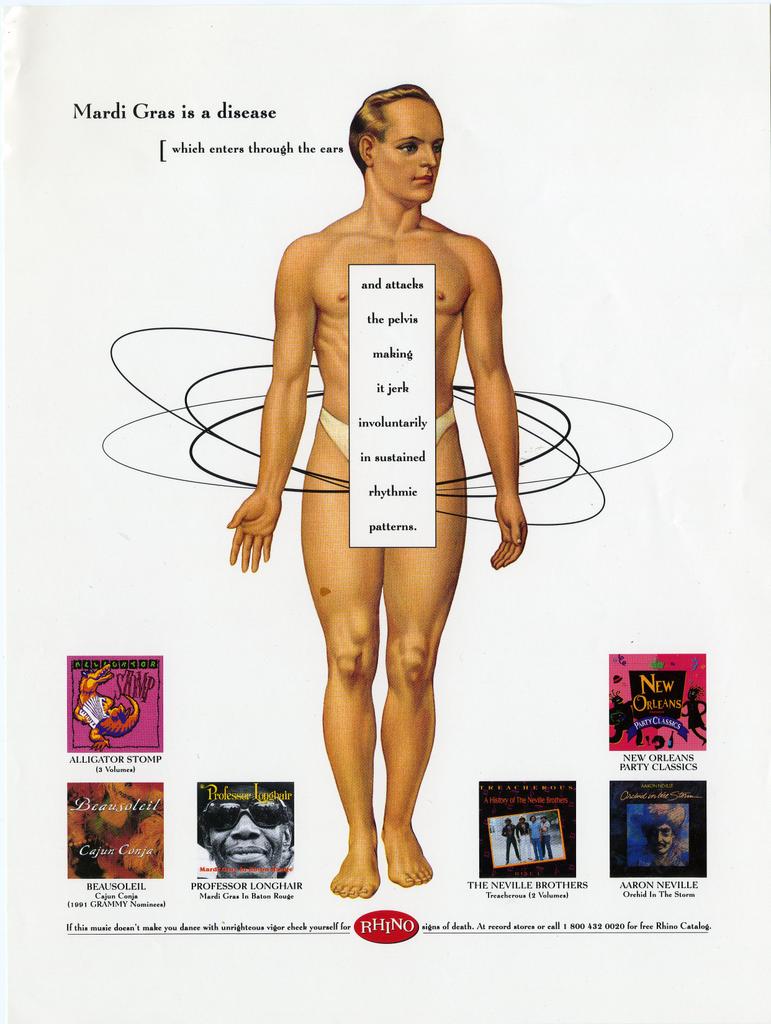
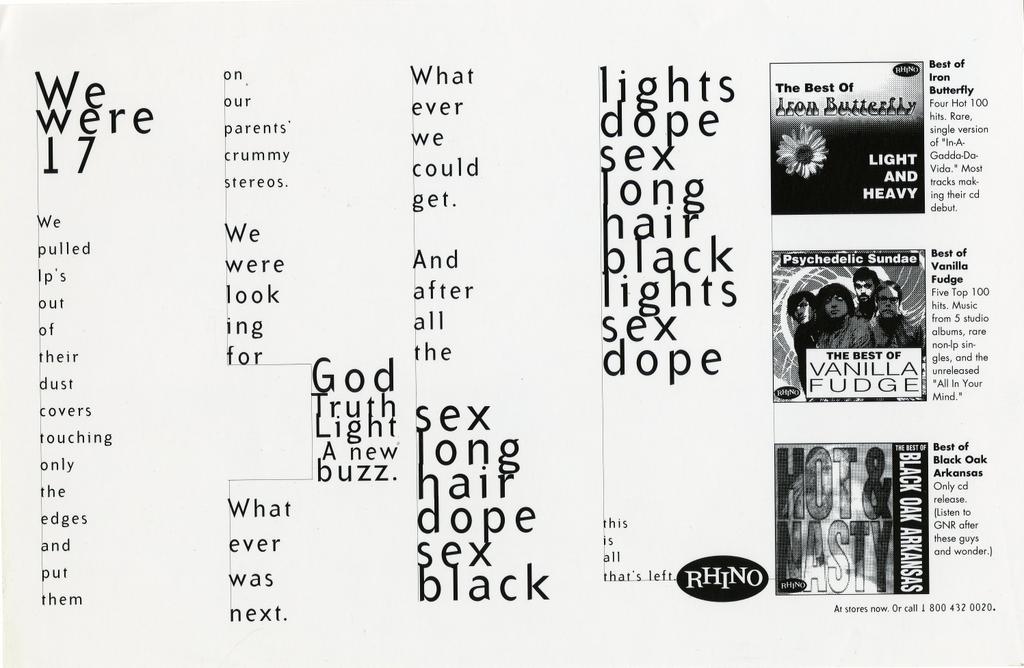
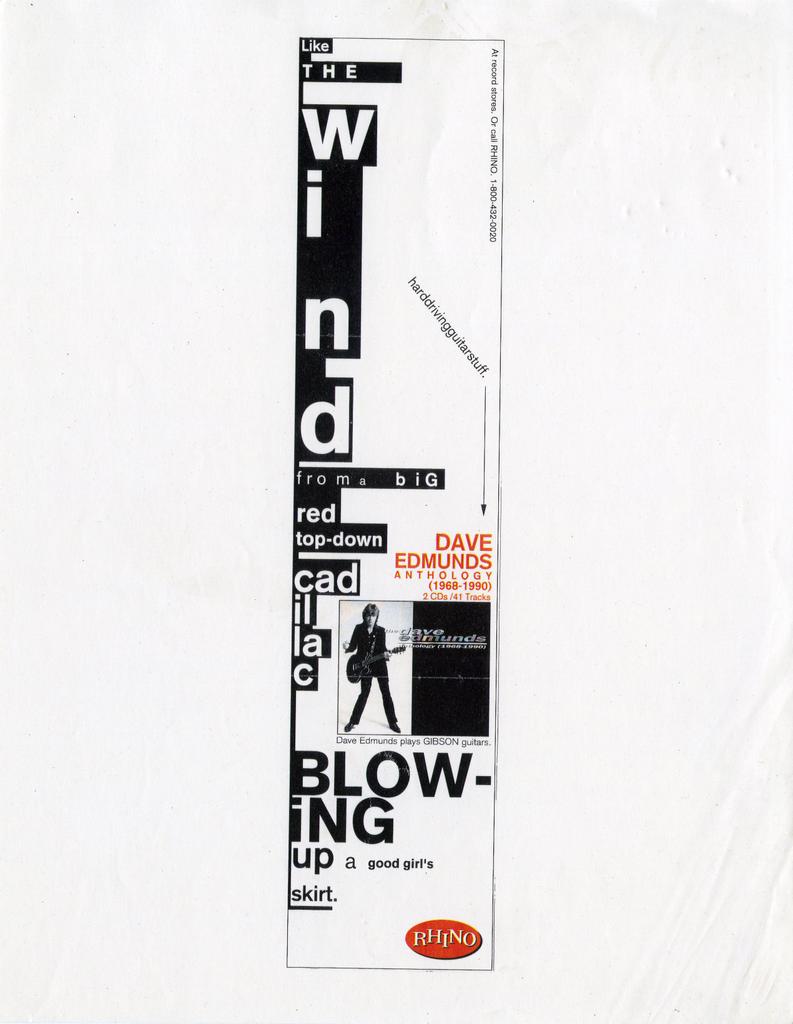
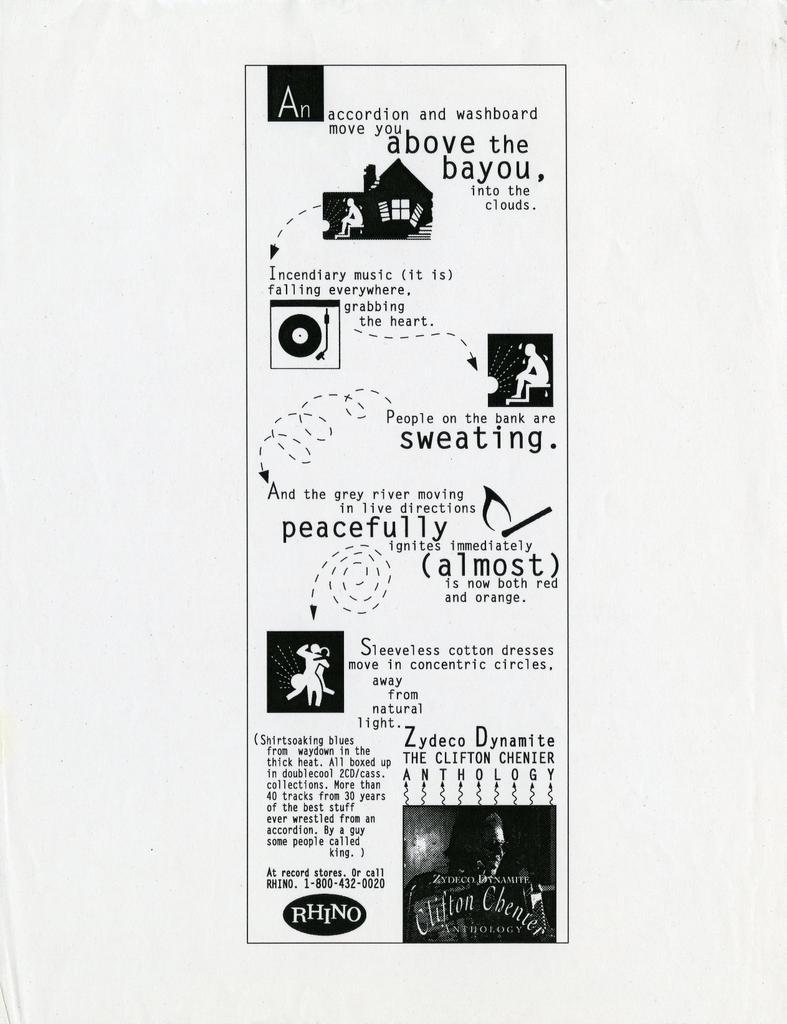
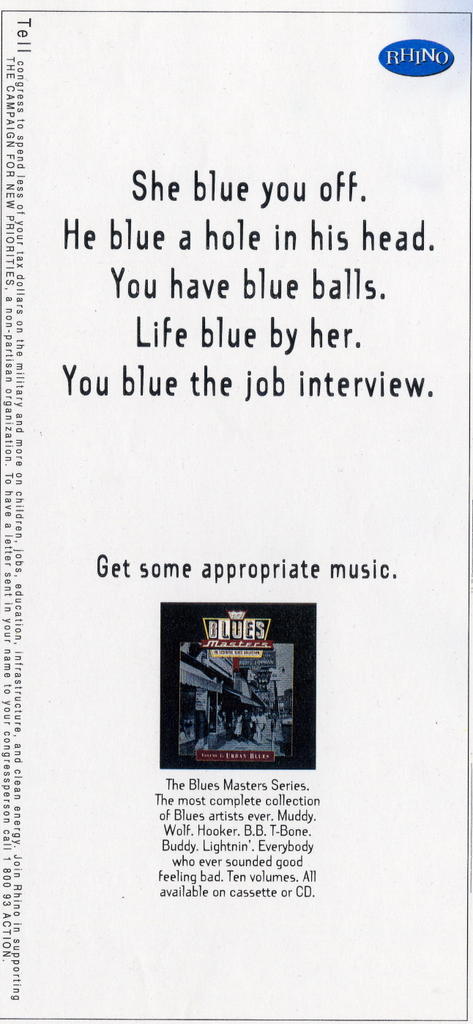
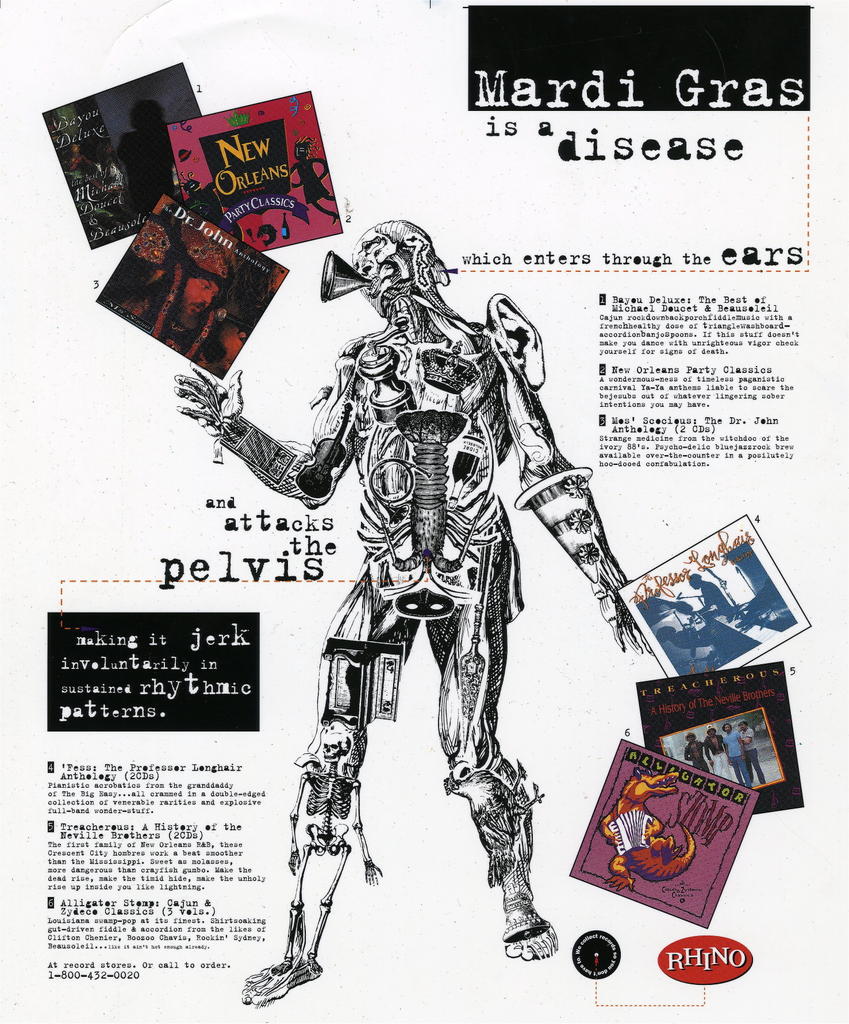
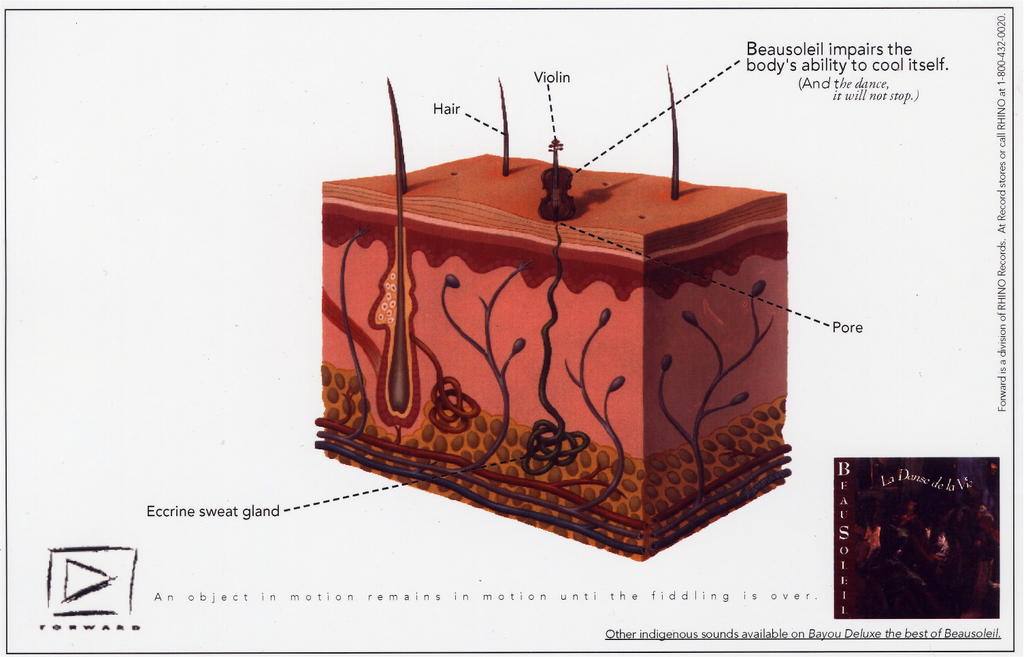
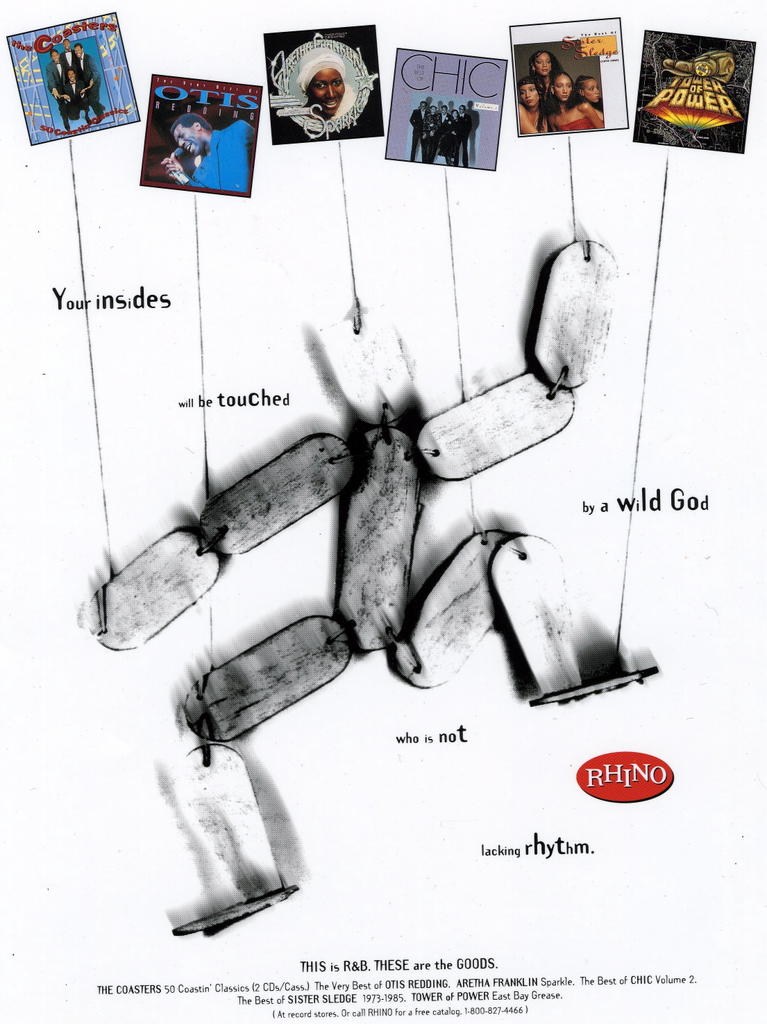
Rhino Records print advertising done by The Bomb Factory in the early 1990’s.

The Bomb Factory was a film production company/ad agency hybrid i ran in Venice CA from 1990 to 1996. Wonderful people worked there.

We didn’t think of it as an unusual place at the time. We wanted to work a lot & we wanted to control the quality of our work. That was all. In retrospect it’s apparent we were trying to be two things at once at a time when it was becoming a difficult world to make money at in either of them.
(creatives: Steve Luker, Rob Palmer, Mark Foster, Kate Flather & Susan Griak. all art directors, but i think they wrote a lot of the best headlines themselves)
(click on ad to open larger view)

I’ll post more of the work as it gets scanned & write more later about our experience, especially the reasons we’re not around today.

Progress comes from mistakes, not success. Pretty much all that comes from success is copying.

Calvin & Hobbes re: Advertising

The boy and the tigger have it right on for 97% of what our business creates.
If you make that kind of work you should be ashamed when you have to tell people you work in advertising.
If you do the other 3%, if you look for the truth & don’t talk till you tell it, you’re part of the most powerful art form on earth at the moment, i think.

Krzysztof Kieslowski. Polish film director. The Decalogue is his masterwork. A series of 10 one-hour films.

The films are based on the 10 commandments. But only loosely. In the director’s words (as quoted in a film review by James Berardinelli): “The relationship between the films and the individual Commandments [is] a tentative one. The films should be influenced by the individual Commandments to the same degree that the Commandments influence our daily lives.”
Also from the director: “we concentrated more on what’s going on inside [the characters] than what’s happening on the outside.”

I know what you’re thinking after reading the above: gee, what a thrill that sounds like! watching 10 hours of introspective films about the Ten Commandments, sheesh, what does this guy think, we’re in an Alabama State Courthouse? I wonder what Adam Sandler has out at the cineplex.
You’ll be missing something.
Is all i can say.

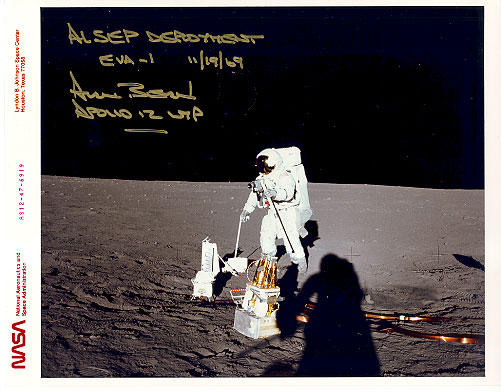
36 years ago today we landed on the moon.

This isn’t a picture of that.
This is 4 months later.
The ALSEP (Apollo Lunar Surface Experiments Package) deployed on the moon.
The reason to go to the moon was for humans to make footprints there.
The experiments stayed longer than the people, though.
My father helped build the one in the picture is why i bring it up.
Sometimes apples do fall a ways from the tree.

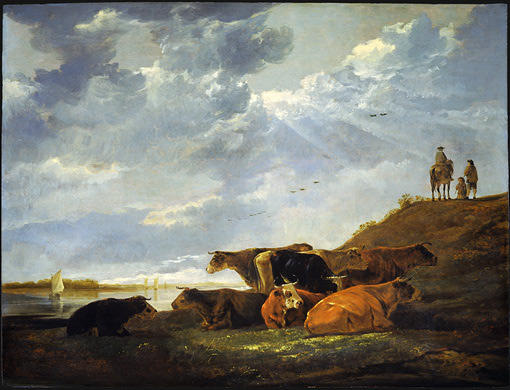
Aelbert Cuyp. Dutch Painter. 1620 – 1691. Lived & painted in Dordrecht.

My favorite painter. For the last two years anyway.

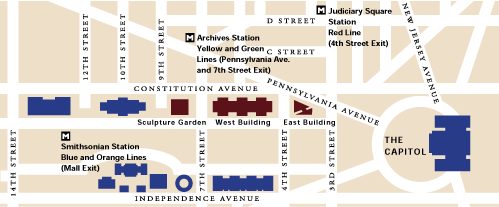
This painting, The Maas at Dordrecht, hangs in the National Gallery in Washington D.C. ——(this is a great & easy trip if you live in Richmond. first, look where the National Gallery is (click on the map below, the National Gallery is in brown & there are two wings) …. it’s right next to the Capitol which is right next to Union Station which is where the train from Richmond lets a person off. It’s an early morning ride to D.C., a walk to the museums, lunch at Cafe Berlin behind the Capitol, and a train home) —— If you didn’t take art history in college–neither did i & i regret it–the beginning of your education could be a trip to this museum, a close reading of the paintings they have & even the slightest notice of the order in which they are arranged.
When i was younger i laughed at art history for how useless it seemed. Later, i laughed at art history majors for how unemployed they were.
I was wrong.

In the history of art you can see man’s time on earth in overview. You see ideas form, flourish, then become infected by a new idea and change into something different, not unlike how the genes of a family progress through time.
I think it’s quite a bit like God must see us. How we reach for ideas. How we urge our selves onto pages of paper, canvases, and carve what we think is us out of rock.
And all of it always in motion, leaning & straining.
Good grief, i was nearly 40 before i saw even bare outlines of thought. Don’t stay stupid as long as me.
{How did i manage to learn so little from working with art directors–besides noticing how good looking they are. How did i miss that they know so much more through their eyes seeing than i got from my eyes reading}
A knowledge of art history, especially one gained on your own from your own reactions to work will teach you more about the world & how it works than anybody in undergrad ever tried to.

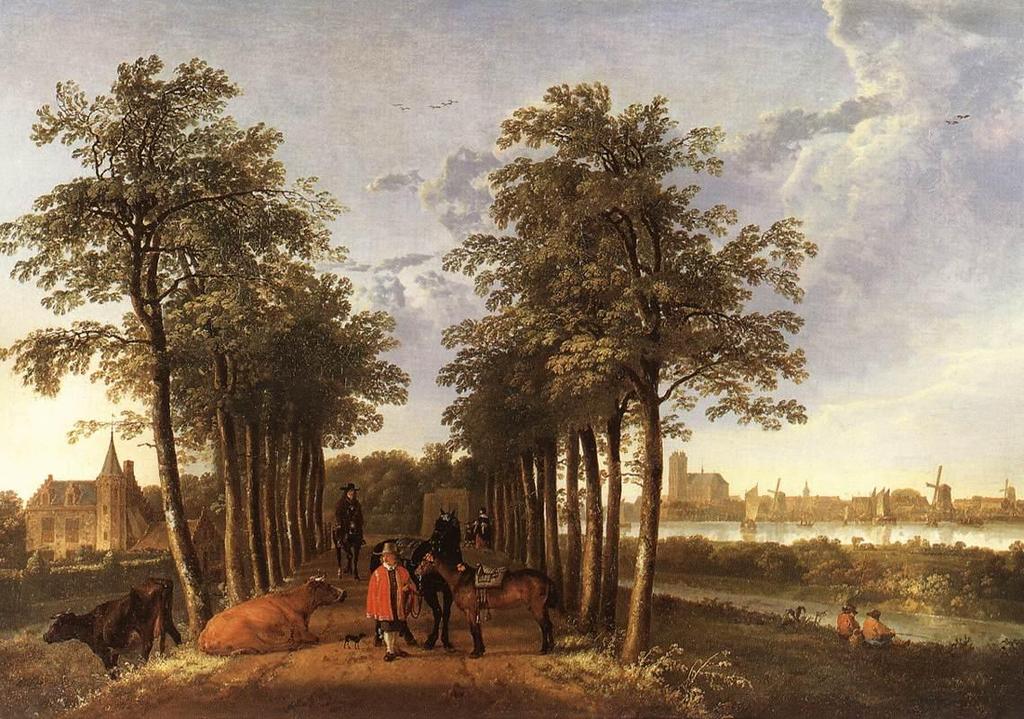
The painting below is another of Cuyp’s. He was part of a family of painters who lived in Holland and painted what i–in un-art-history-educated parlance–would call ecstatic realism. He looked at the world he lived in, saw beauty in actual settings, and painted them, mostly as a mirror of what he saw but beyond that, also, way beyond, to make the image contain the wonder he felt existed in such scenes. It is difficult for the audience today to imagine the impact of having the normal become the subject of such highly charged painting. Such apprehension is not above those with an appreciation of art history, even so little as i have.

A poem about being a writer by a guy who would know.

so you want to be a writer?

if it doesn’t come bursting out of you
in spite of everything,
don’t do it.
unless it comes unasked out of your
heart and your mind and your mouth
and your gut,
don’t do it.
if you have to sit for hours
staring at your computer screen
or hunched over your
typewriter
searching for words,
don’t do it.
if you’re doing it for money or
fame,
don’t do it.
if you’re doing it because you want
women in your bed,
don’t do it.
if you have to sit there and
rewrite it again and again,
don’t do it.
if it’s hard work just thinking about doing it,
don’t do it.
if you’re trying to write like somebody
else,
forget about it.

if you have to wait for it to roar out of
you,
then wait patiently.
if it never does roar out of you,
do something else.

if you first have to read it to your wife
or your girlfriend or your boyfriend
or your parents or to anybody at all,
you’re not ready.

don’t be like so many writers,
don’t be like so many thousands of
people who call themselves writers,
don’t be dull and boring and
pretentious, don’t be consumed with self-
love.
the libraries of the world have
yawned themselves to
sleep
over your kind.
don’t add to that.
don’t do it.
unless it comes out of
your soul like a rocket,
unless being still would
drive you to madness or
suicide or murder,
don’t do it.
unless the sun inside you is
burning your gut,
don’t do it.

when it is truly time,
and if you have been chosen,
it will do it by
itself and it will keep on doingit
until you die or it dies in you.

there is no other way.

and there never was. ————- by Charles Bukowski

what the poem hits so well is something that gets shown to me to be truer and truer every year: it’s a gift to be a writer. it’s not something you can aspire to or work your way into becoming.
yes, the job is made up of hard work.
however, it’s not hard work that gets you the job.

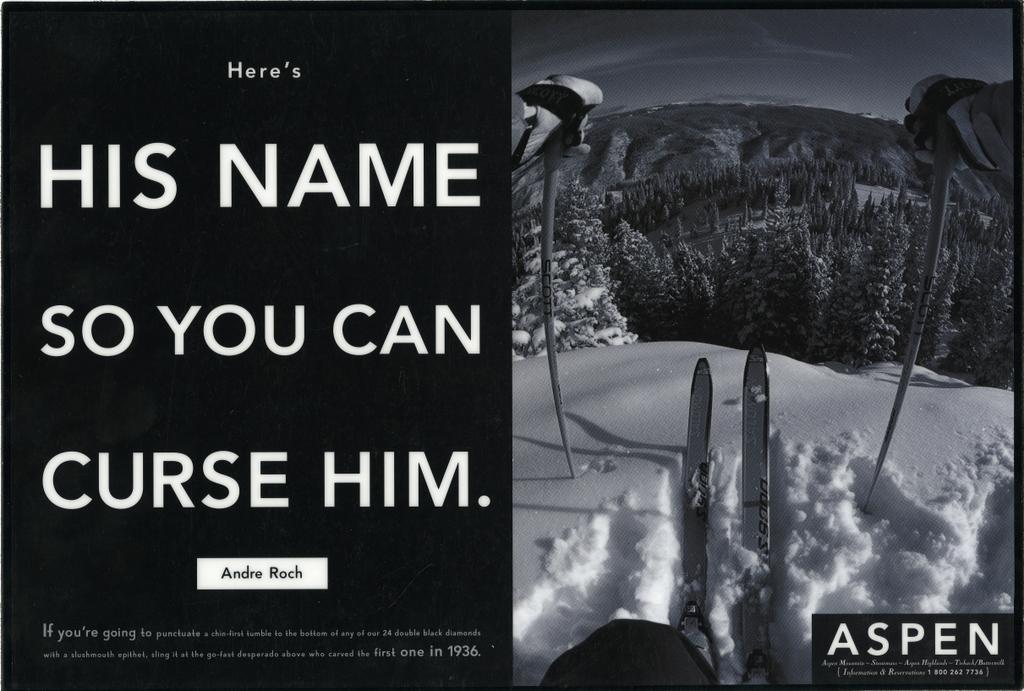
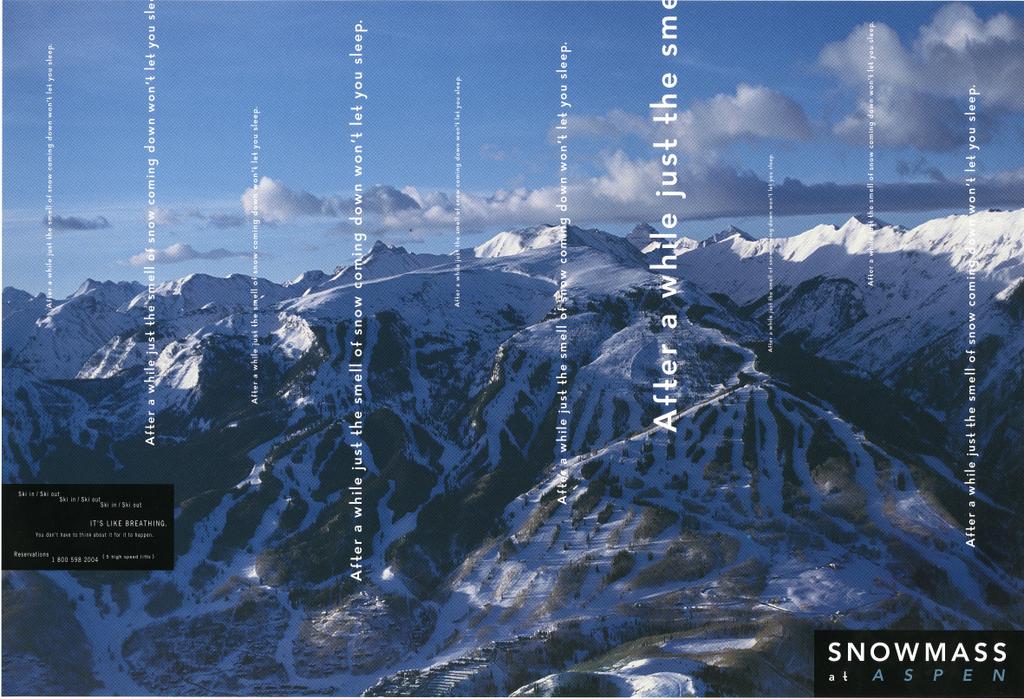
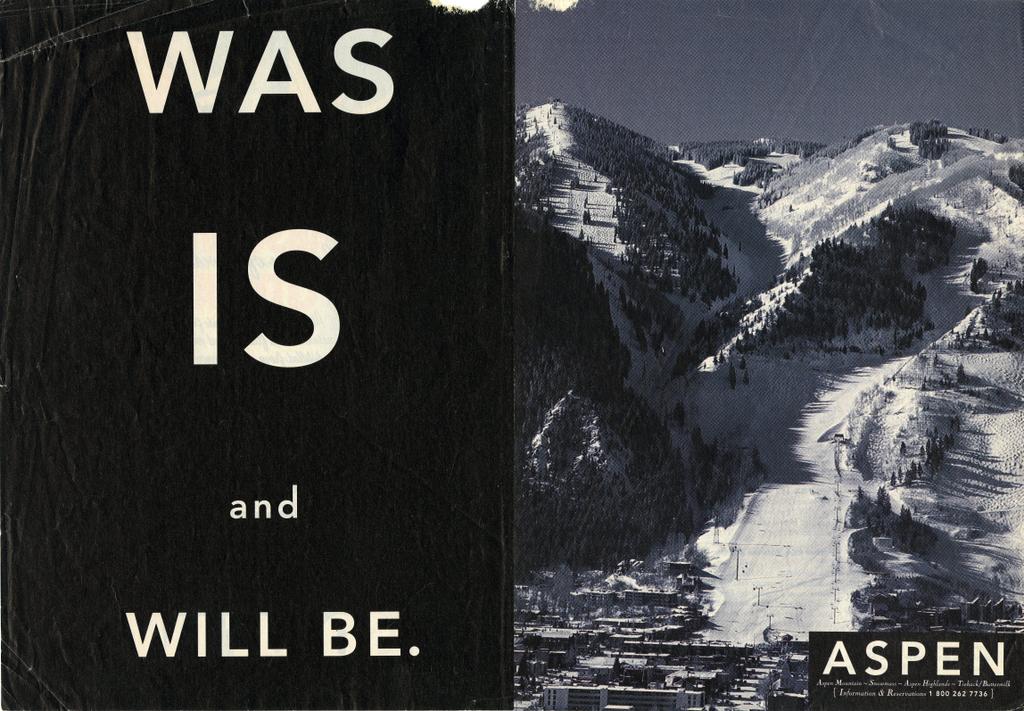
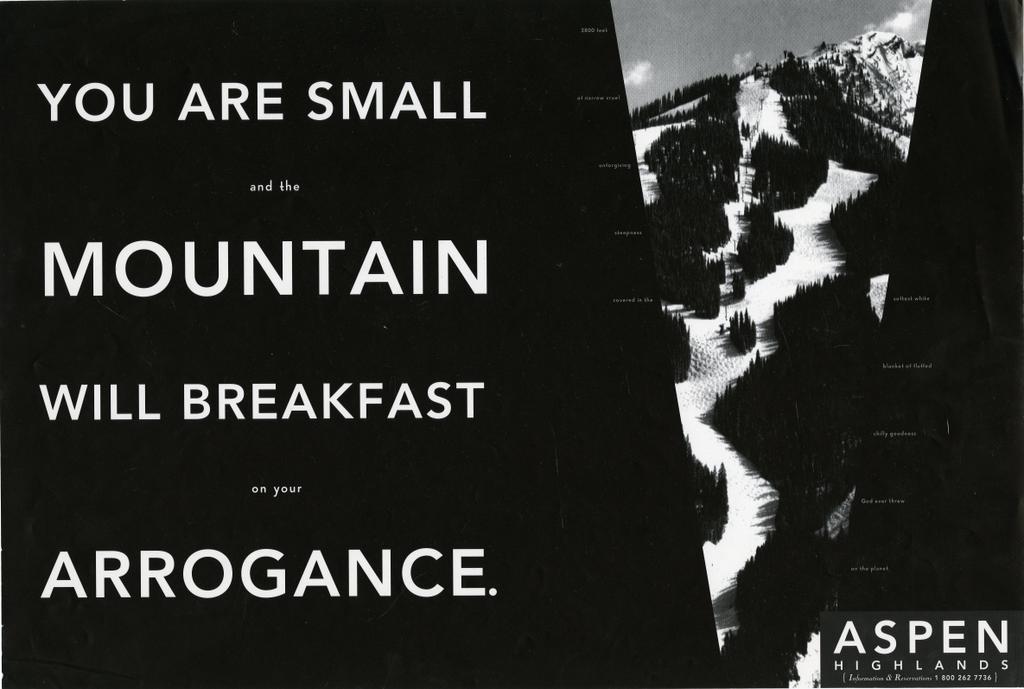
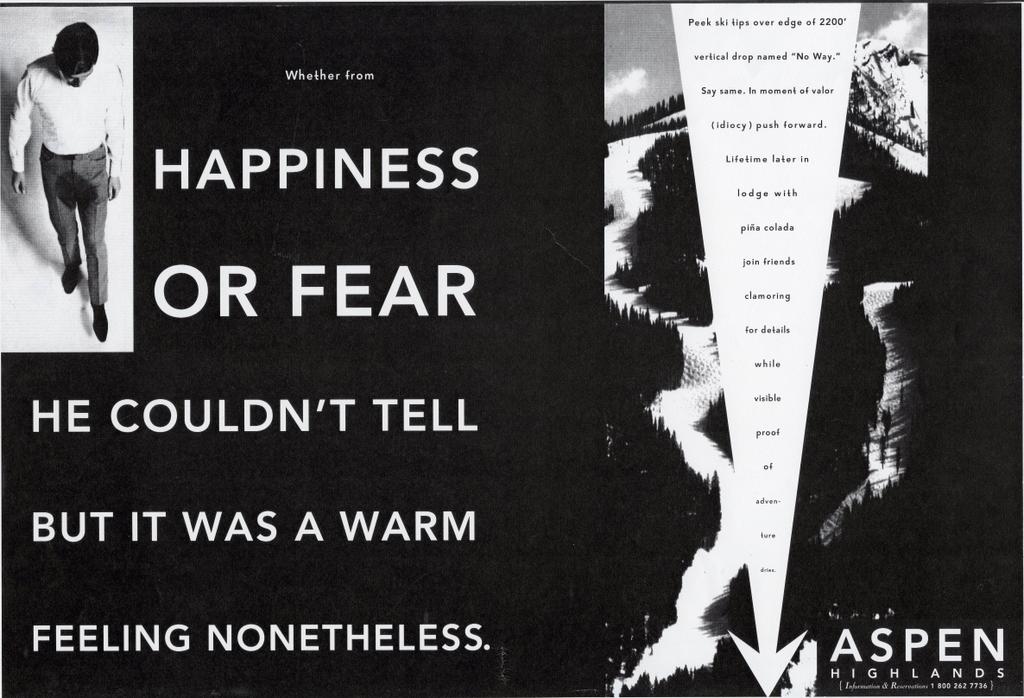
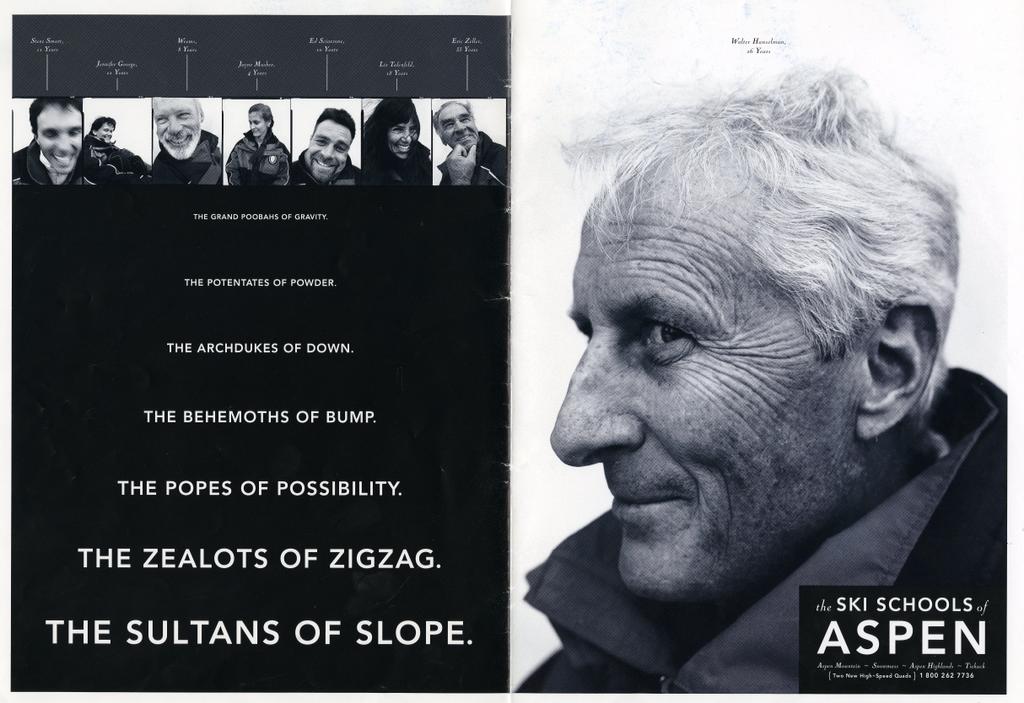
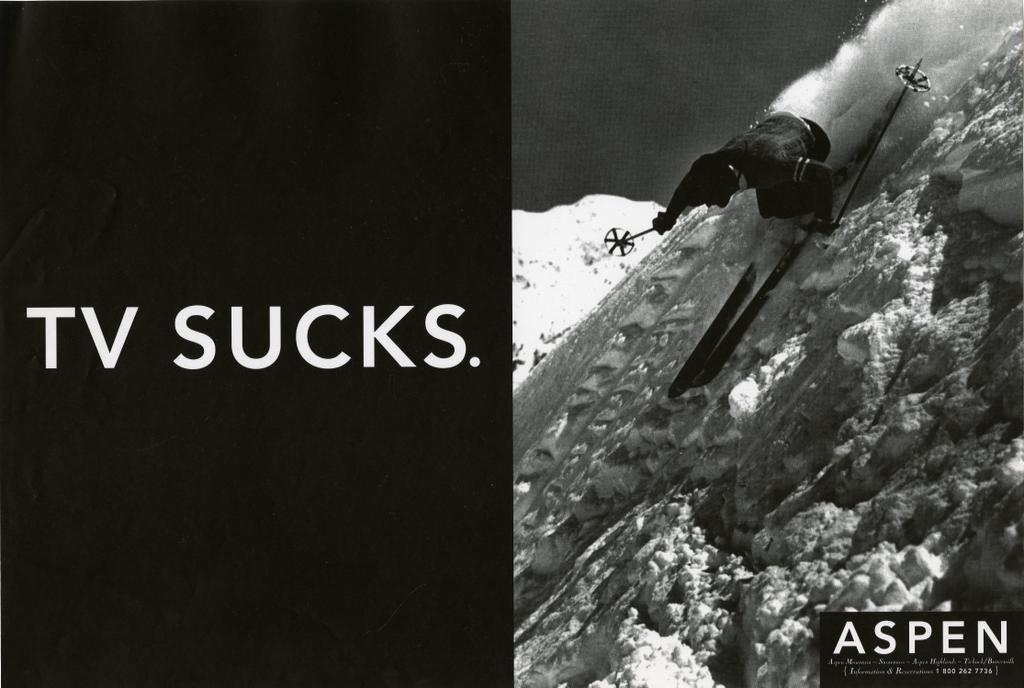
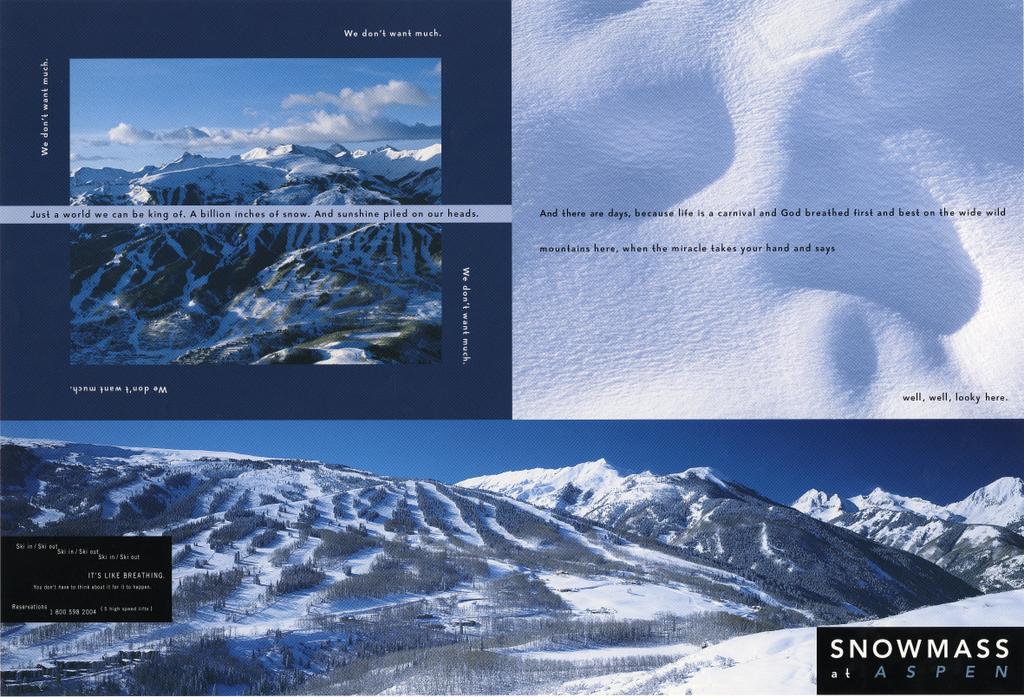
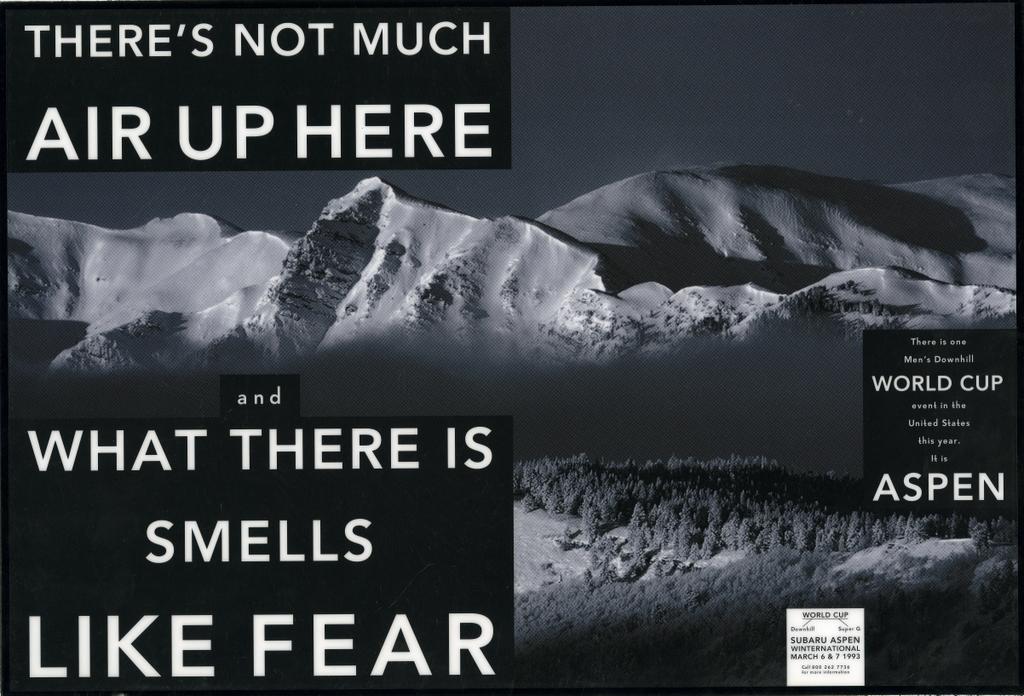
Aspen Ski Company ads. 1993 to 1995

(click on photo to see in readable size)

This ad was done for Cole & Weber/Seattle.
The art director was Steve Luker.
There isn’t much work you do in advertising that you can look at 12 years later without embarrassment.
The culture catches up and turns the headline you were at the time convinced was fresh & true & insightful into a recitation of a hackneyed anachronism. Or, sometimes the product disappears, and you feel like sheesh, you must have done it all wrong.
I still like this one.
It is past the time when the effect of the ad on the public can be felt in the same way it was in 1993. Nevertheless, the aim of the ad seems clear, no? Part of a campaign done for the Aspen Ski Company, which runs two different resorts in the Aspen area–the big one, Aspen Mountain, in the town of that name, and Snowmass, which is a 15 minute drive away–the ads for Snowmass spoke of a big, mostly intermediate mountain especially suited for cruising.
The Aspen area wasn’t having any trouble attracting the rich & famous, ermine-wearing nightlifers. It seemed to us there wasn’t a corresponding sense that it was a great place to ski, which, to Luker and I, it not only seemed to be but had to be to justify the extra travel required to get to Aspen as compared to its main competitor, Vail.
So the campaign we did reads like it was written by a speed-smitten narrator who was just like you, the reader, except he was looking at things from a higher, not-involved perspective.
If i had to redo them now I guess i’d write them with a little less sure of themselves tone. A fault i would like to remove from a lot of work i’ve done.
{Talk about stupid: while we worked on the Aspen account they would give us these plastic coated passes on a lanyard, the kind ski patrolers have around their neck, that let us ski free all season. In the 3 years i worked on the account i skied at Aspen maybe 4 days. Next time you think somebody is stupid, put me on the list above them}
p.s. No focus group was consulted in the creation of the ads.
p.p.s Look up the art director in the award books. He’s a giant.

A few of the other ads in the campaign, if you’re interested: